

Weitere Details, Bitte hier klicken
1. Superior Comfort, Less Risk of “Air Conditioning Sickness”
Gentle, non-stinging air supply
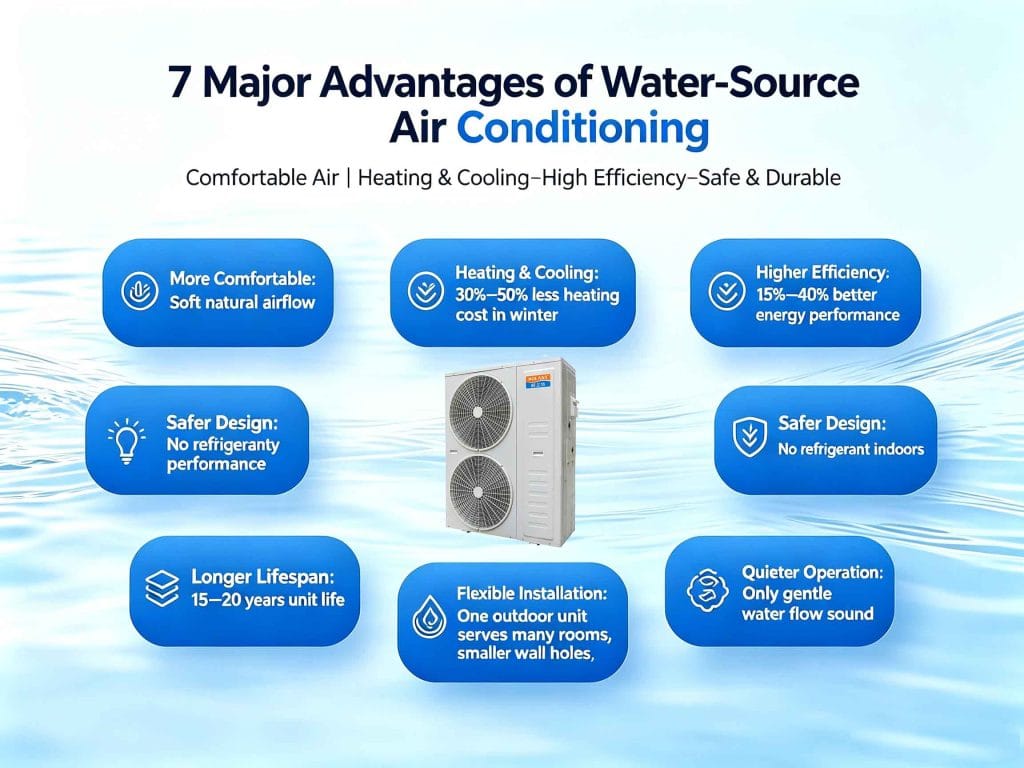
Refrigerant units operate at an evaporator temperature of 7–12°C, creating a large temperature difference between supply air and room air. Their cold airflow feels harsh and can cause joint discomfort under direct blow.
Water systems circulate chilled water at 12–15°C, delivering mild cold air that diffuses evenly like natural breeze—ideal for the elderly, children and pregnant women for long stays.
Balanced indoor humidity without dryness
Low-temperature coils of refrigerant units remove excessive moisture, dropping indoor humidity to only 30%–40%, leading to dry throat, chapped skin and itchy eyes.
Water systems avoid over-dehumidification and maintain a comfortable humidity range of 45%–55%, eliminating the need for extra humidifiers.
Uniform whole-house temperature with minimal fluctuation
Water has high specific heat capacity and strong heat storage capacity, resulting in stable water temperature and room temperature fluctuation within ±0.5°C with no sudden hot/cold shifts.
Refrigerant units rely on frequent compressor start-stop cycles for temperature control, creating uneven heat distribution: cold near air outlets and warm room corners with obvious temperature stratification.
2. Integrated Cooling & Heating, Ideal for Floor Heating with Lower Winter Power Consumption
One unit handles both air conditioning and floor heating
Water systems can supply chilled water to fan coils for cooling and low-temperature hot water to underfloor pipes for heating, covering year-round thermal demands with one outdoor unit.
Refrigerant units only deliver heated air and cannot directly connect to underfloor heating; installing an additional boiler raises costs and occupies extra space.
30%–50% less power consumption in winter heating
Water systems supply 40–45°C low-temperature hot water for radiant floor heating, with warmth rising gently from the ground for cozy, non-dry heating.
Heat pump performance of water systems decays far less than refrigerant units under frigid outdoor temperatures (below -10°C), making them vastly more energy-efficient in cold northern regions.
3. Lower Operating Electricity Bills for Large Spaces & Long Continuous Operation
Better energy efficiency during full-load, all-day operation
For villas, shopping malls, offices and hotels with large areas and long daily usage, water systems achieve 15%–40% higher overall energy efficiency than refrigerant units. The longer the continuous running time, the wider the energy-saving gap.
Long-distance pipeline delivery with low heat loss
Water pipes have far lower flow resistance than copper refrigerant pipes and can transport cold/hot water over 500+ meters. Single outdoor units suffice for multi-story villas without multiple external units, cutting pipeline heat loss.
Copper refrigerant pipes have strict length limits; long pipelines trigger higher refrigerant loss and power consumption.
4. Higher Safety & Eco-friendliness, Lower Hazard from Leaks
No refrigerant inside living spaces to avoid suffocation risks
Refrigerant systems run copper pipes throughout every room. Leaks of R32/R410A may lead to suffocation in enclosed spaces, and some refrigerants are flammable.
All refrigerant of water systems is sealed inside the outdoor unit; only water flows through indoor pipelines. Leaks merely cause water seepage with no toxic gas hazards.
Reduced greenhouse gas impact
Refrigerant split systems fill entire indoor copper piping with refrigerants, and any leakage exacerbates global warming. Water systems hold a much smaller total refrigerant volume confined to the outdoor unit, slashing leakage risks and environmental harm.
5. Longer Service Life & Better Durability
Design lifespan of refrigerant air conditioners: 8–12 years
Design lifespan of water system main units: 15–20 years. Separate replaceable components (water pumps, fan coils) cut long-term replacement costs.
6. Flexible Installation for Large Buildings & Wide Compatibility
Capacity to serve dozens of rooms
One single water outdoor unit can drive dozens of fan coils, perfect for villas, duplexes, shopping malls and office buildings. Refrigerant multi-split units have strict limits on total capacity and room count; large residences need multiple outdoor units that occupy more exterior space.
Smaller wall/beam drilling holes
Water pipes are thin with slim insulation layers, requiring smaller holes when passing through walls or beams. Thick copper refrigerant pipes with bulky insulation need larger drilling, causing greater structural impact on load-bearing beams.
7. Quieter Operation
Heat exchange in fan coils is gentle with faint water flow noise. Refrigerant units generate obvious airflow and fluid noise from fast refrigerant circulation, plus loud startup/inverter cycling sounds that disturb nighttime rest.
Disadvantages of Water-based Air Conditioning (Objective Comparison)
Slower initial cooling (5–10 minutes longer); cooling speed improves significantly with water storage tanks for secondary startups.
Higher upfront procurement and installation costs.
Regular water circuit maintenance required (pipe cleaning, antifreeze addition); minor risk of water leakage.
Energy-saving advantages disappear for small apartments or intermittent use of only 1–2 rooms.
Application Scenario Summary
Choose water-based air conditioning if you have: villas/large flats, year-round full-house operation, underfloor heating demands, elderly/children living long-term, cold northern climates, shops, hotels or office buildings.
Choose refrigerant split air conditioning if you have: small apartments, occasional use of few rooms, limited budget or short-term residence.
AI graph