

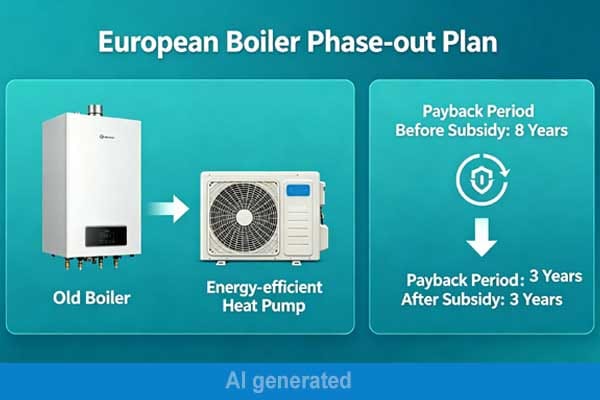
For household applications, the payback period of a heat pump investment is generally 4–8 years, while for commercial and industrial scenarios it can be as short as 1–3 years. The duration mainly depends on initial investment, annual energy-saving benefits, subsidies, energy efficiency ratio, and operating hours.
Key variables affecting the cycle:
Energy Efficiency (COP)
Energy Prices
Subsidy Policies
Building Insulation
Operating Hours
IV. Typical References (2026)
- High-subsidy regions in Europe: 2–4 years
- Low-subsidy states in the U.S.: 7–10 years
- Commercial hot water / drying projects: 1–3 years
V. Long-Term Value
Heat pumps have a service life of 15–20 years, delivering pure annual savings after payback.
Traditional boilers only last 8–12 years, making heat pumps more cost-effective over their full life cycle.
European and American customers pay close attention to government tax credits (such as the U.S. Section 30C tax credit) or subsidies (like Europe’s Boiler Replacement Scheme). Such subsidies can often significantly shorten the payback period by 3 to 5 years.