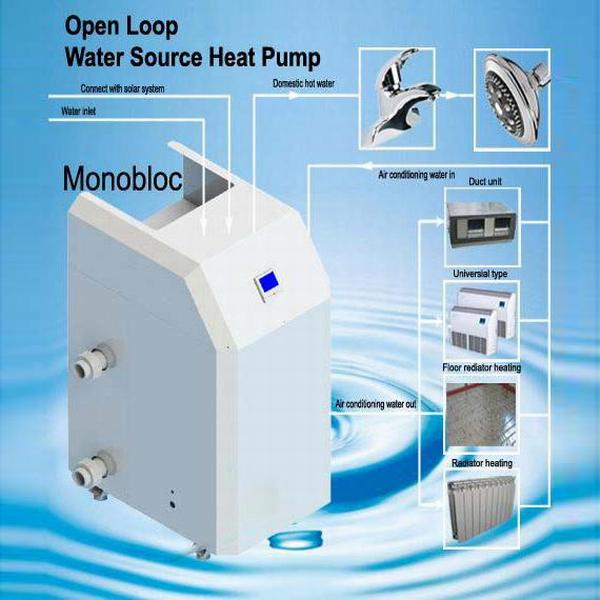


The working principle of a heat pump is based on the reverse refrigeration cycle, which enables it to move heat rather than generate heat directly. The system mainly consists of four core components: a compressor, a condenser, an expansion valve, and an evaporator.
First, the refrigerant absorbs low-temperature heat from the surrounding environment—such as air, soil, or water—in the evaporator. Even in cold weather, the refrigerant can still capture available heat energy. Then, the compressor pressurizes the refrigerant, significantly increasing its temperature and turning it into high-temperature, high-pressure gas.
Next, the hot refrigerant flows into the condenser, where it releases the accumulated heat to heat water or warm the indoor space. After releasing heat, the refrigerant cools down and passes through the expansion valve, where its pressure and temperature drop sharply. It then returns to the evaporator to absorb heat again, forming a continuous closed cycle.
In cooling mode, the process is simply reversed: the heat pump absorbs heat indoors and releases it outdoors, achieving a cooling effect. Driven by only a small amount of electricity, a heat pump can transfer several times more heat energy, which explains its high efficiency and energy-saving advantages. This stable, reliable, and eco-friendly cycle makes heat pumps widely used in residential and commercial heating, cooling, and hot water systems.